

On Rumi, meeting, and the places where our categories dissolve
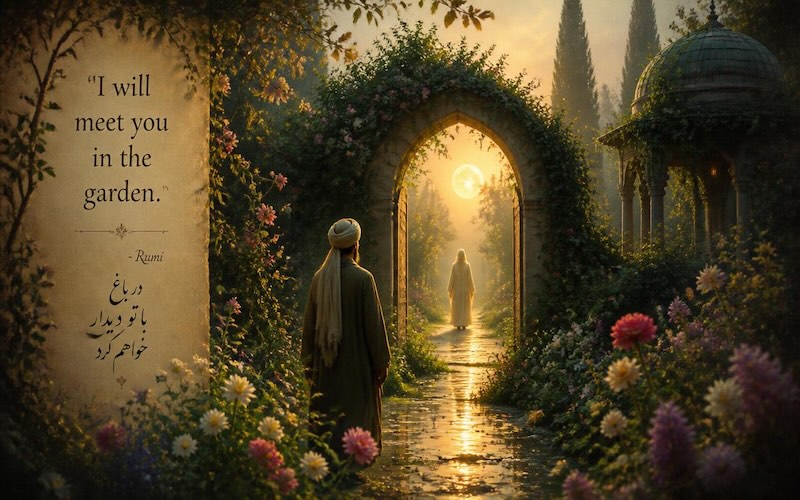
“Somewhere beyond right and wrong, there is a garden. I will meet you there.”
And perhaps the moment we think we have exhausted their meaning is precisely the moment we drift furthest from it.
These words do not merely challenge our understanding of right and wrong. They challenge our understanding of meeting itself.
For what does it mean to meet?
Modernity has trained us to think of meeting as proximity—two people occupying the same space, sharing the same moment, exchanging words, glances, or gestures. Yet the mystics, lovers, and poets have always known that reality is far more mysterious than that.
We spend entire lifetimes surrounded by people whom we never truly meet. We share homes, workplaces, cities, and histories, yet remain strangers behind carefully constructed selves. And then there are those whom we encounter only briefly—or perhaps never at all in the conventional sense—yet they continue to inhabit our inner world, accompanying us across years and continents, shaping our becoming in ways that defy explanation.
Perhaps meeting is not a matter of bodies drawing near.
Perhaps it belongs to an entirely different order of reality.
Perhaps the deepest meetings occur precisely where the boundaries of self and other begin to soften; where recognition replaces acquaintance; where presence transcends proximity; where something within us encounters something within another and discovers a familiarity older than memory itself.
The garden Rumi speaks of may not be a place beyond moral categories alone. It may be a place beyond all our habitual definitions—a realm where reality is no longer fragmented by the concepts through which we ordinarily perceive it.
What Does It Mean to Meet?
Before we can ask what lies beyond right and wrong, we have to sit with this stranger question for a while, because it is the hinge on which Rumi’s whole line turns. We assume we know what meeting means. We assume it is something that happens to us, from the outside—an event with a time stamp, a location, two names in a sentence together. But the moment we try to locate our most formative meetings in space and time, something resists.
Heidegger has a name for the ordinary mode in which we exist alongside others: Mitsein, being-with. But he is careful to distinguish this from authentic encounter. Most of our being-with, he says, is a kind of Fürsorge that has collapsed into mere proximity—we “leap in” for each other, manage each other, perform roles for each other, without either of us ever showing up as the singular, irreplaceable being we actually are. Two people can be thoroughly with each other in this sense for forty years and never once meet. The marriage, the friendship, the family is real—but it is populated by masks attending to masks.
And then, occasionally, something else happens. A stranger says one sentence, and it lands somewhere that ordinary speech doesn’t reach. A person we will likely never see again leaves a mark that outlasts people we’ve known for decades. Why?
Rumi himself begins the entire Masnavi with this very ache—the reed cut from the reed bed, crying not from pain but from memory:
بشنو از نی چون حکایت میکند وز جداییها شکایت میکند
هر کسی کو دور ماند از اصل خویش باز جوید روزگار وصل خویش
Listen to this reed, how it tells its tale, complaining of separations.Everyone who has been parted from their origin longs for the day of reunion.
The reed’s cry is not the cry of a stranger encountering something foreign. It is the cry of recognition—the sound a thing makes when it remembers where it came from. If this is what separation feels like from the inside, then perhaps meeting is simply this same recognition running in the other direction: not the discovery of someone new, but the reed, for a moment, hearing an echo of its own reed bed in another.
Ibn Arabi would point us toward something almost unbearably literal: the Day of Alast, the primordial covenant in which every soul, before entering this world, stood in the presence of God and recognized itself as belonging to Him. Every human being carries the residue of that recognition, whether they remember it consciously or not. When two people meet “in the garden,” Ibn Arabi suggests, what is actually occurring is that something in one soul recognizes, in another, the trace of that same original encounter—the same root in the Divine Names, the same note from the same first chord. This is why such meetings feel less like discovery and more like remembering. We are not learning something new about the other person. We are recognizing something we had, in some sense, always known.
Kierkegaard arrives at a structurally similar place from the opposite direction. For him, the deepest reality of a person is not their public biography—their roles, achievements, opinions, the things that can be listed on a résumé or summarized in a sentence to a third party. It is what he calls inwardness: the solitary relation of the single individual to their own existence, to their choices, to God. Two people can exchange an enormous amount of information about their outward lives and never once touch this inward register. But when inwardness meets inwardness—even briefly, even through nothing more than a glance, a piece of writing, a shared silence—something occurs that no exchange of information could produce. This, too, is a meeting that does not require proximity in the ordinary sense, because inwardness is not located inspace to begin with.
So perhaps this is the first thing the garden asks us to release: the assumption that meeting is primarily a spatial and temporal event. If the deepest layer of a person is not “in” their body in the way their elbow is in their sleeve—if it is, instead, something closer to a note, a frequency, a trace of an older recognition—then two such layers can touch across a room, across a page, across years, across the gap between the living and the dead. Proximity can host a meeting. It cannot guarantee one. And its absence cannot prevent one.
The Garden Is Not a Suspension of Morality—It Is a Suspension of the Self That Judges
It would be easy to misread Rumi’s line as a kind of moral relativism, an invitation to step outside ethics altogether. But that is not what the Sufis meant by “beyond right and wrong.” Ibn Ata’illah, in his Hikam, repeatedly returns to a single insight: most of our suffering comes not from the world itself, but from our compulsive need to label, categorize, and pass verdict on everything that happens to us and around us. He writes of the heart that has surrendered—not a heart that has stopped caring about right and wrong, but one that has stopped using right and wrong as weapons against reality, against others, and against itself.
The very first aphorism of the Hikam sets the tone for everything that follows:
مِن علاماتِ الاعتمادِ على العملِ، نُقصانُ الرَّجاءِ عند وجودِ الزَّلَلِ
Among the signs of relying on one’s own deeds is the diminishing of hope whenever a lapse occurs.
On the surface, this looks like a statement about religious practice. But its deeper implication is exactly what Rumi’s garden points toward: as long as our inner peace depends on a verdict—on whether we (or others) have been “right” or “wrong” in a given moment—that peace will be as unstable as the verdict itself. Hope, presence, the capacity to meet another person without flinching—none of these can be built on a foundation of constant moral accounting. Ibn Ata’illah is not telling us to stop trying to act well. He is telling us that the ground of our wellbeing has to come from somewhere other than the scoreboard.
This is the first unpacking of the garden. It is not a place where ethics no longer matter. It is a place where the self that needs to be right—the self that needs the other to be wrong in order to feel secure—has quietly stepped aside. Rumi is not asking us to abandon discernment. He is asking us to abandon the part of us that uses discernment as a fortress wall.
Ghazali, centuries earlier, made a similar distinction in his account of the heart (qalb). For Ghazali, there are two kinds of knowing: the knowledge of the jurist, which deals in categories, rulings, permissible and forbidden—necessary, but operating on the surface of things—and the knowledge of ma’rifa, direct gnosis, which arises only when the heart’s mirror has been polished clean of the rust of ego, anger, envy, and self-justification. The garden, in Ghazali’s terms, is what becomes visible once that rust is removed. Right and wrong do not disappear; they simply stop being the lensthrough which everything must first pass before it can be seen.
The Imaginal Realm: Where Two People Can Actually Meet
Ibn Arabi gives us perhaps the most precise map for what this garden might be. He speaks of alam al-khayal—the imaginal realm—and of the barzakh, the threshold or in-between that is neither fully this world nor fully the next, neither pure spirit nor pure matter, but the meeting-place of both. It is the realm of dreams, of visions, of the subtle recognitions that happen between people that cannot be accounted for by anything they said or did.
This is crucial for understanding Rumi’s “I will meet you there.” If meeting only happened in physical space and clock-time, the line would be sentimental at best. But Ibn Arabi gives us a metaphysics in which the barzakh is real—as real as the room you’re sitting in, perhaps more so, because it is less conditioned, less crowded with the noise of ego and circumstance.
It is Ibn Arabi who gives us, in the Tarjuman al-Ashwaq, one of the most famous lines in the entire mystical tradition—a heart so widened by love that it can no longer be confined to a single form, creed, or category:
لقد صار قلبي قابلاً كل صورة فمرعى لغزلانٍ وديرٌ لرهبانِ
My heart has become capable of every form: a meadow for gazelles, a cloister for monks…
He goes on to list a temple of idols, the Ka’ba of the pilgrim, the tablets of the Torah, the pages of the Qur’an—not as a renunciation of any of them, but as a heart that has become spacious enough to hold what they all point toward. This is the garden in miniature: not the erasure of forms, but a heart no longer imprisoned by any single one of them, able to recognize the same source moving beneath gazelle and monk, idol and scripture alike.
Consider how often this plays out in ordinary life. Two people can sit across a table for years, performing the social contract of “knowing” each other, and never once meet in this deeper sense. And then there are those fleeting exchanges—a conversation with a stranger, a passage in a book, a person who appears for a season and then vanishes—that leave something behind, something that keeps unfolding inside us long after the encounter has ended. Ibn Arabi would say: that is not a memory. That is a meeting that is still happening, in the barzakh, in the garden, outside the jurisdiction of clock-time.
Kierkegaard and the Suspension of the Ethical
It would be a mistake to treat this only as an Islamic mystical idea with no echo in the Western tradition. Kierkegaard, in Fear and Trembling, wrestles with Abraham’s binding of Isaac and arrives at what he calls the “teleological suspension of the ethical”—a moment in which the single individual, standing alone before God, finds themselves in a relation that the universal (the realm of ethics, of right and wrong as society defines them) cannot fully judge or contain.
Kierkegaard is not telling us that ethics is false. He is telling us that there is a register of existence—faith, the absolute relation to the Absolute—that ethics, as a system, cannot reach. The “knight of faith” lives in the world, follows its rules, looks utterly ordinary—and yet inwardly inhabits something the crowd has no access to. This is Kierkegaard’s garden: not a place outside the law, but a place where the individual’s relationship to truth becomes too intimate, too singular, to be adjudicated by the categories that work perfectly well for everyone else.
This is why Rumi says I will meet you there, and not we will agree there, or we will be judged there. The garden is not a courtroom with better verdicts. It is a place where the very apparatus of verdict-giving falls silent, because what is happening between two people (or between a person and God, or a person and themselves) has become too particular, too alive, to be filed under a category.
Centuries later, and in an entirely different idiom, Iqbal arrives at something strikingly close to Kierkegaard’s “single individual” in his own reflections on khudi—selfhood:
خودی کو کر بلند اتنا کہ ہر تقدیر سے پہلے خدا بندے سے خود پوچھے، بتا تیری رضا کیا ہے
Raise your selfhood so high that, before every destiny is written, God Himself asks His servant: tell me, what is it that you will?
This is not arrogance—it is Iqbal’s version of the knight of faith: a self so attuned, so inwardly real, that it is no longer merely processed by fate or by the crowd’s verdicts, but stands in a living conversation with the Absolute. It is precisely this kind of self—singular, awake, no longer outsourcing its inner life to das Man or to the scoreboard of right and wrong—that is capable of meeting another self in the garden, rather than merely colliding with it.
Heidegger: Stepping Out of “Das Man”
Heidegger gives us a more secular but strikingly compatible vocabulary. He describes most of our everyday existence as governed by das Man—”the they,” the anonymous public that has already decided, in advance, how one should feel, judge, and react to everything. We absorb its verdicts so completely that we mistake them for our own thoughts. Most of what passes for “right and wrong” in daily life is simply das Man speaking through us.
Authentic existence, for Heidegger, is not a different set of beliefs—it is a different relation to one’s own existence, a stepping out of the crowd’s pre-packaged interpretations and into what he calls the clearing (Lichtung): a space in which beings can show up as they actually are, rather than as the categories have already decided they must be.
This is strikingly close to Rumi’s garden. The clearing is not “beyond ethics” in the sense of anarchy—it is beyond the inauthentic version of ethics, the borrowed, crowd-sourced, performative version that most of us run on most of the time without noticing. To meet someone in the clearing is to meet them before das Man has finished its commentary—before you’ve decided what kind of person they are, what side they’re on, what they deserve.
The Modern Context: A Civilization Addicted to Verdicts
We live, perhaps more than any generation before us, inside a machine that runs on right and wrong. Social media has turned moral judgment into a reflex, almost a tic—a way of establishing, within seconds, which side of an invisible line a person stands on, and therefore how much of our attention, compassion, or contempt they are entitled to. Entire relationships, online and offline, are now organized around this sorting. We perform our verdicts publicly, not because we have thought deeply about them, but because nothaving a verdict feels like exile from the group.
In such a world, Rumi’s garden is not a nostalgic retreat into vague spirituality. It is closer to an act of resistance. To say “I will meet you there” is to say: before I decide what you are, before I file you under a label that will determine how I treat you, I want to meet you—the thing in you that exists prior to and beneath all of that.
This does not mean we stop holding views, or stop caring about justice, or stop calling things by their names. Ghazali was a jurist as well as a mystic; Ibn Arabi did not abandon the Sharia; Kierkegaard did not abandon ethics, only its claim to be the final word. What changes is the order of things. The garden comes first. The verdicts, if they are needed at all, come after—and they come gentler, because they are no longer being used to protect a fragile self.
Why Some Meetings Never End
This is perhaps why certain people never leave us, though they may have stayed only a moment, while others remain physically present for decades without ever truly arriving. The ones who stay are the ones we met in the garden—however briefly the gate opened. Something in us recognized something in them that predates both of our biographies, something Ibn Arabi might call a shared root in the Divine Names, something Rumi’s whole ouevre circles around as the soul recognizing its own original home.
And the ones who never arrive, despite years of proximity, are perhaps those with whom we have only ever transacted—exchanged roles, performed categories, traded verdicts—without the gate ever opening at all.
Iqbal, writing in Urdu, captures the rarity of this kind of recognition with an image that returns us, almost too perfectly, to Rumi’s own word for this place:
ہزاروں سال نرگس اپنی بے نوری پہ روتی ہے بڑی مشکل سے ہوتا ہے چمن میں دیدہور پیدا
For a thousand years the narcissus weeps over its own blindness; only with great difficulty does a true seer arise in the garden.
Chaman—the garden—is full of forms, of flowers, of life. What is rare is not the garden itself, but the deeda-war, the one whose seeing has ripened enough to actually meet what is there. Perhaps this is the final turn of Rumi’s line. The garden beyond right and wrong is not hidden, not far away, not reserved for the next life. It is here, as ordinary and as overgrown as any garden—what is missing, most of the time, is not the garden but the eye capable of meeting it.
I will write more on this soon: on what it means to meet beyond the conventional meanings of meeting, and why presence is not the same as proximity, and absence is not always the same as distance.
For now, I only want to leave this:
The garden is not far away. It is not reserved for saints, or for the dead, or for some future reconciliation. It is available in this conversation, this glance, this moment—the instant we set down the part of ourselves that needs to win, to be right, to be safe by being correct.
Rumi is not describing a place we might one day reach.
He is describing a door that is, even now, slightly open.
HASHIYA is free today. But if you enjoyed this post, you can tell HASHIYA that their writing is valuable by pledging a future subscription. You won’t be charged unless they enable payments.